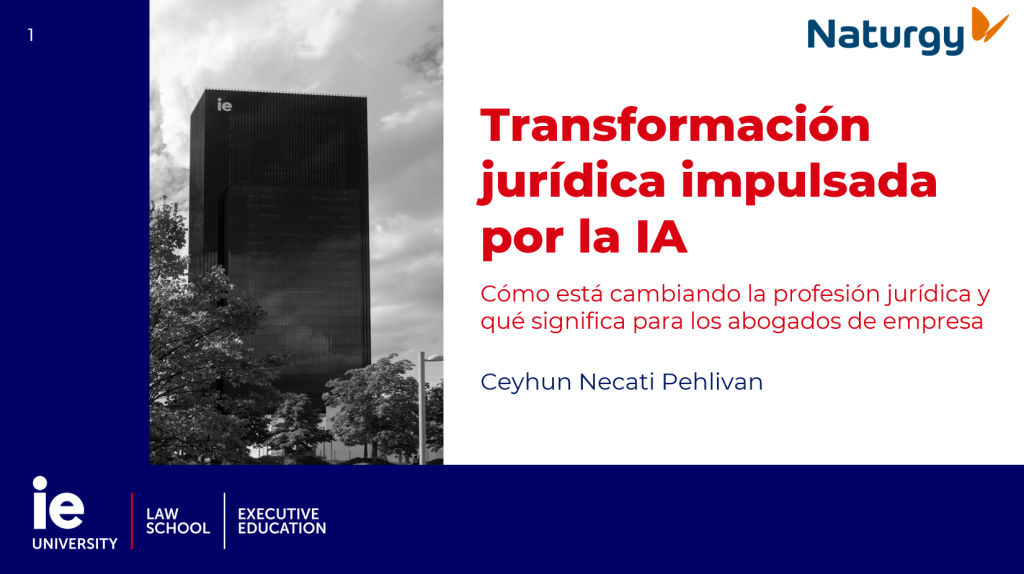
Last week, I had the pleasure of speaking to the legal team of Naturgy at IE University as part of a programme on digital transformation and the future of the legal function.
While artificial intelligence was naturally a central topic, the discussion quickly moved beyond AI tools themselves. Instead, we explored how legal teams are evolving, how lawyers can create greater value for the business and how organisations can prepare for a future in which change is becoming a constant.
AI Is Part of a Longer Story
There is a tendency to treat AI as something entirely new. In reality, the legal profession has always adapted to technological change.
Email transformed communication. Online legal databases changed legal research. Electronic signatures accelerated contracting processes. Digital collaboration tools reshaped the way legal teams operate.
AI is the latest stage in that evolution.
Like previous technologies, AI has the potential to improve efficiency, automate routine tasks and increase productivity. The difference is the speed of adoption and the breadth of activities that AI can support.
The Rise of the Augmented Lawyer
Much of the debate around AI focuses on whether lawyers will be replaced by technology.
In my view, the more relevant question is how lawyers can use technology to become more effective.
AI can assist with legal research, document review, contract analysis, due diligence and compliance activities. However, legal practice involves much more than processing information. It requires judgment, commercial awareness, strategic thinking and the ability to understand context.
For that reason, the future is unlikely to belong either to lawyers who ignore technology or to technology operating without human oversight. Instead, it will belong to lawyers who successfully combine legal expertise with technological capabilities.
A More Strategic Legal Function
At the same time, the role of the legal department continues to evolve.
Legal teams are increasingly expected to support business strategy, facilitate innovation and help organisations navigate growing regulatory complexity. Technical legal expertise remains essential, but it is increasingly complemented by commercial understanding, adaptability and a willingness to embrace new ways of working.
Technology is accelerating this shift by enabling lawyers to focus more of their time on higher-value activities and less on routine administrative work.
Looking Ahead
One aspect that stood out during the session was the quality of the discussion and the level of engagement from the participants.
Naturgy has assembled an impressive legal team, and the conversation reflected a group of lawyers who are thinking carefully about how the profession is evolving and how they can continue to create value in a rapidly changing environment.
Ultimately, the future of the legal function is not simply a question of technology. It is about how lawyers adapt, develop new capabilities and position themselves to support their organisations in an increasingly complex world.
Many thanks to Macarena Alcantara and Maria Eugenia Trujillo from Naturgy for organising the programme. I am also grateful to Macarena Plaza and Marina García from IE University for their excellent coordination and for making the programme possible.